
Texas has no red flag law (extreme risk protective order, or ERPO) in force, and no bill filed for the 90th Legislature can change what happens in a courtroom before September 1, 2027 at the earliest. If you own firearms, the real worry is a charge, a court order, or exposure at work and in the press. Today that risk comes from current law, including violent crime charges that carry firearm consequences.
This post separates what has been filed, what current law already does, and what is only a category to watch. We make no predictions about passage. Prosecutors already bring federal gun prosecutions under statutes in force, and the sooner a defense team reviews an order, a police inquiry about firearms, or a pending charge, the more options remain.
What Gun Bills Has The 90th Legislature Received?
The 90th Legislature received roughly 35 firearm-related bills on the first day of prefiling for the 2027 session, according to NRA-ILA. The NRA Institute for Legislative Action reported that prefiling began Monday, November 9, 2026, and that the session gavels in January 12.
That count is a first-day figure, and it will grow while filing stays open. Carry locations, age limits, permitless carry changes and bans on enforcing federal gun rules are categories to watch, not filed bills we have reviewed. Texas Legislature Online, at capitol.texas.gov, is the official source for bill text, status, fiscal notes and analyses.
Does Texas Have A Red Flag Law Today?
No. According to Texas Gun Sense, reprinting The Washington Post, Texas was already among 29 states without one before S.B. 1362, sponsored by state Rep. Cole Hefner (R).
A red flag law lets a civil court temporarily remove firearms from a person a judge finds to be a danger to self or others. Here, “bill” means a pending proposal, and “law” means an enacted statute.
What S.B. 1362 Prohibits
S.B. 1362, the Anti-Red Flag Act, bars Texas from adopting or enforcing most ERPOs. Texas Gun Sense, reprinting The Washington Post, reports that Gov. Greg Abbott signed it in 2025 and that laws from that session take effect September 1.
The same source reports that the law bars judicial authorities from using civil red flag orders to take a person’s guns. It threatens criminal penalties, including jail time, for anyone who tries to enforce one.
It also blocks Texas entities from accepting federal dollars to enforce an ERPO. It declares any federal emergency protective order law that violates Second Amendment rights unenforceable in Texas.
According to KUT 90.5 (Texas Public Radio), the House Criminal Jurisprudence Subcommittee approved S.B. 1362 on May 8, 2025, after a public hearing. A red flag bill in the 90th Legislature would have to reverse this statute.
Which Orders Texas Judges Still Issue
Texas judges still issue ERPOs in criminal cases and for existing domestic violence protection orders, according to Texas Gun Sense. The ban targets civil orders sought with no charge pending. It does not reach firearm limits tied to a criminal case or a family-violence protective order.
Red Flag Orders Versus Existing Texas Firearm Bars
Texas already bars firearms through convictions, protective orders, bond conditions and emergency detention. A red flag order would add a bar where there is no charge and no protective-order grounds.
Penal Code § 46.04 starts with a conviction, and the State enforces it by prosecution. Family Code chapter 85 protective orders follow an application by the protected person or a prosecutor and a hearing, and generally last up to two years.
A magistrate’s emergency order under Code of Criminal Procedure article 17.292 follows an arrest for family violence and lasts weeks, not years. Bond conditions are set by the court in a pending case and end with it. Together, these drive most family-violence charges involving guns.
Emergency detention under Health and Safety Code chapter 573 holds a person for evaluation. Detention alone is generally not a “commitment” under federal rules, so it does not by itself trigger 18 U.S.C. § 922(g)(4). A later court order for inpatient mental health services can.
A red flag order would let a family member or officer seek removal with no charge, no conviction and no family-violence finding.
| Mechanism | Trigger | Who files | Charge required | Duration |
|---|---|---|---|---|
| Penal Code § 46.04 | Felony or family-violence conviction | State prosecutes | Yes, a conviction | While prohibition applies |
| Protective order (Fam. Code ch. 85) | Family-violence finding | Applicant or prosecutor | No | Term of the order |
| Emergency order (art. 17.292) | Arrest for qualifying offense | Magistrate | Arrest | Set in the order |
| Bond conditions | Pending criminal charge | Judge sets terms | Yes, pending | While case is pending |
| Emergency detention (ch. 573) | Mental-health danger | Officer or petitioner | No | Short detention period |
| Red flag order | Judged danger, no charge | Varies by state | No | Temporary, hearing follows |
Figure 1: A red flag order would fill the gap where no charge exists and no protective order applies. Source: Tex. Penal Code § 46.04; Tex. Fam. Code ch. 85; Tex. Code Crim. Proc. art. 17.292; Tex. Health & Safety Code ch.
When Would A 2027 Bill Take Effect?
Most laws from the 2027 session take effect September 1, 2027. Nothing changes before then unless a bill sets another date or passes by a two-thirds vote in each chamber for immediate effect. All dates here are calculated from the constitutional schedule for a 140-day regular session.
What Are The Session Deadlines?
Five dates matter this session.
- Monday, November 9, 2026: pre-filing opens.
- Tuesday, January 12, 2027: the 90th Legislature convenes.
- Friday, March 12, 2027: the 60th-day deadline for non-emergency bills, so the bill list stays open until then.
- Monday, May 31, 2027: sine die, the 140th day.
- Sunday, June 20, 2027: the governor’s veto deadline, 20 days after adjournment.
Do New Laws Reach Earlier Conduct?
No. A new criminal offense reaches only conduct on or after its effective date, because the ex post facto principle bars retroactive criminal liability.
Suppose a new weapons offense takes effect September 1, 2027. Conduct on August 31, 2027 is prosecuted under the old law, or not at all if it was legal then. Conduct on or after September 1 falls under the new one.
Possession is different because it continues. A person who keeps a newly prohibited firearm from August into September can be charged only for the days after the effective date. The transition clause and the dates alleged in the charging document decide which law applies.
What Penalties Apply To A Barred Gun Owner?
A barred gun owner who keeps a firearm faces a Penal Code § 46.04 charge, and sometimes a federal charge under 18 U.S.C. § 922(g), which can carry up to 15 years. The state charge has three variants.
- Felon possession, § 46.04(a): third-degree felony, 2 to 10 years in prison and a fine up to $10,000.
- Possession within five years after release from a family-violence conviction, § 46.04(b): Class A misdemeanor, up to one year in county jail and a fine up to $4,000.
- Possession while subject to a protective order, § 46.04(c): Class A misdemeanor, same range.
The federal rung adds § 922(g)(8), which bars possession under qualifying domestic protective orders. The Supreme Court upheld it on its face in United States v. Rahimi (2024). After the 2022 Bipartisan Safer Communities Act, § 924(a)(8) sets a 15-year maximum for federal firearm charges under § 922(g).
A state red flag order would not automatically trigger § 922(g)(8). That provision requires an order protecting an intimate partner or child, issued after a hearing with notice and a chance to participate.
A defense review first checks the prosecuting county, the grade charged and the Chapter 12 range. Federal exposure then shifts the forum, and how federal cases differ shapes every later decision.
How Do You Read A 2027 Bill?
On Texas Legislature Online, check the caption, operative sections, effective-date section and transition clause, then the fiscal note and bill analysis. The transition clause states whether the change applies only to offenses committed on or after the effective date. The Legislative Budget Board writes the fiscal note, and committee or House Research Organization analyses summarize intent.
Why 2025 Bill Numbers Mislead
Bill numbers restart each regular session, so HB 234, HB 478 and HB 655, cited by advocacy pages, are 89th Legislature numbers, not 2027 bills. A 90th Legislature bill with the same number can address something unrelated. Confirm a bill’s session on Texas Legislature Online before trusting any claim about it.
The check runs in order: caption, operative sections, effective date, transition clause, fiscal note, analysis.
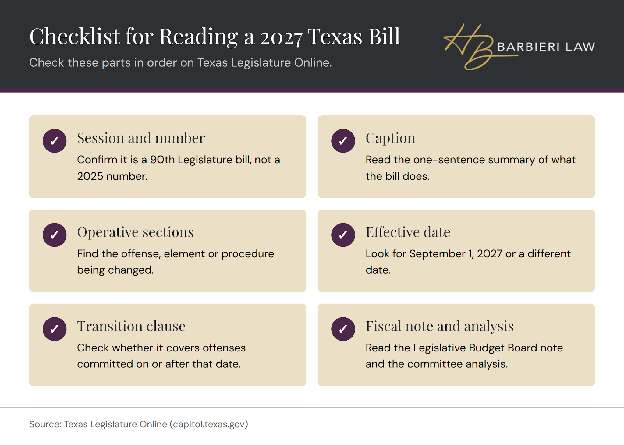
Figure 2: The effective date and transition clause decide whether a bill touches your case. Source: Texas Legislature Online (capitol.texas.gov).
Four Questions That Test Any Bill
Four questions test any bill: where it stands, what it changes, when it takes effect, and whom it reaches.
1. Status: confirm the filing and its current committee or calendar stage.
2. Effect: identify whether it creates an offense, changes an element or changes procedure.
3. Timing: read the effective-date section.
4. Reach: read whether the transition clause covers pending cases.
A red flag bill is civil and procedural in form. Violating the resulting order can still create criminal liability.
Which Other Criminal Bills Should You Watch?
Four non-gun areas deserve a watch: bail and pretrial release, DWI, human trafficking, and sex-offense penalties. We name no bill numbers, because pre-filing opened only November 9, 2026. For each area, watch the pre-filed list.
- Bail and pretrial release
- DWI
- Human trafficking
- Sex-offense penalties
The count is small now and will grow until March 12. Past sessions have widened existing offenses, as an earlier offense expansion of the endangerment statute showed.
Frequently Asked Questions
Objections To Red Flag Orders
Opponents argue a no-charge order removes property and rights under the Second Amendment and Texas Constitution art. I, § 23 without due process. Supporters answer that a hearing and a temporary term supply that process. Courts test these laws under the Bruen history-and-tradition standard.
How A Bill Becomes Texas Law
A bill becomes law after it is filed, referred to committee, heard, and passed by both chambers in identical form. The governor then signs it, vetoes it, or lets it become law without a signature. Its effective date follows the bill’s own terms.
How We Read New Gun Laws For Clients
We read a new bill the way a briefing reads it: offense grade, Penal Code section, punishment range, prosecuting county and transition clause. If you hold firearms and face an order, a police inquiry about guns, or weapon-related charges, the exposure reaches your work and your name as well as the case. We handle both together, with a second attorney assigned and former-prosecutor insight into how the State builds its case.
At Barbieri Law Firm, P.C., a dedicated in-house investigator led by Kim Voigt-Eanes works alongside the legal team from day one. The sooner our trial team is involved, the more options remain, including nondisclosure or expunction where the law allows, though no outcome is promised. Every conversation is private.