Texas clears a record in two ways. An expunction destroys arrest and case records, and an order of nondisclosure hides them from the public.
How your case ended decides which one you can use, even after misdemeanor charges resolve in your favor. A visible arrest can cost a job, a license, a school seat or a lease.
The Texas statute says expunction, not expungement, so that is the term used here. A dismissal helps, but what a dismissal leaves behind stays on background checks until a court orders otherwise. Results depend on the record, and none can be assured.
Which Case Outcomes Qualify For Each Route?
Your case outcome decides the route. Expunction fits outcomes without a conviction.
Nondisclosure fits completed deferred adjudication and some misdemeanor convictions. Felony convictions and excluded offenses have no route.
Each of ten outcomes maps to a route, an earliest date and a statute:
- Arrested, never charged: expunction. File 180 days after arrest for Class C, one year for Class A or B, and three years for a felony. CCP Chapter 55A.
- Charges dismissed: expunction. File when limitations runs. You can file sooner if the court finds the dismissal rested on mistake, false information or lack of probable cause, or if it followed a pretrial intervention program. CCP Chapter 55A.
- Acquitted: expunction. You can act immediately, and the trial court can enter the order on request within 30 days of the acquittal. CCP Chapter 55A.
- Pardoned, or granted relief for actual innocence: expunction. File once the pardon or relief is granted. CCP Chapter 55A.
- Class C deferred disposition: expunction. File after the case is dismissed. CCP Chapter 55A.
- Class A/B or felony deferred adjudication: nondisclosure, automatic for qualifying misdemeanors and by petition otherwise. Act on discharge for most misdemeanors, two years after discharge for certain misdemeanors, and five years after discharge for felonies. Gov’t Code 411, Subchapter E-1.
- Misdemeanor conviction: petition nondisclosure. File after completing the sentence, or two years later for certain offenses. Gov’t Code 411, Subchapter E-2.
- First-offense DWI conviction: petition nondisclosure. File two to five years after completing the sentence. Subchapter E-2.
- Felony conviction: none, absent a pardon.
- Offense on the §411.074 list: no nondisclosure. Expunction remains open only if no conviction or deferred adjudication occurred.
Class C deferred disposition, long cited as CCP Art. 45.051, ends in dismissal, and that dismissal opens the expunction path.
Gov’t Code §411.074 bars nondisclosure for several offense groups. These include offenses requiring sex offender registration, murder, aggravated kidnapping, trafficking, injury to a child or elderly person, stalking, violating a protective order and any offense with a family-violence finding. A prior conviction or deferred adjudication for one of these offenses also bars relief.
When Can You File Under Chapter 55A?
With no charge filed, you wait 180 days for a Class C arrest, one year for Class A or B, and three years for a felony. You can file sooner if limitations has run or the prosecutor certifies the records are not needed.
Expunction moved from CCP Chapter 55 to Chapter 55A on January 1, 2025. Older forms and articles still cite Chapter 55, and a petition should cite the current chapter.
Take a worked example. Someone is arrested on January 15, 2025, for first-offense theft of $100 to $750 under Penal Code §31.03. That is a Class B misdemeanor carrying up to 180 days in jail and a $2,000 fine under Penal Code §12.22.
No charge is filed. The one-year filing date is January 15, 2026.
A hearing cannot be set earlier than 30 days after filing, so the earliest hearing falls in mid-February 2026. Courts generally treat the signed order as final 30 days later if no agency appeals.
The agencies named in the order must then return or destroy their records. A realistic span from arrest to removal across agency and private databases runs about 15 to 18 months.
These waiting periods apply to arrests where no charge was filed. Dismissed and acquitted cases follow their own triggers, listed in the lookup above.
What Blocks An Expunction In Texas?
A conviction, a pending charge, or a felony or Class A/B deferred adjudication blocks an expunction. The rule runs by arrest, so one ineligible charge can defeat the whole petition.
Four mistakes sink petitions:
- Filing for expunction after Class A/B or felony deferred adjudication. The court denies it, because deferred adjudication blocks expunction except for Class C. Nondisclosure is the correct filing.
- Expecting a partial expunction. If a felony charge from the same arrest ended in conviction or is still pending, the related misdemeanor generally cannot be expunged either.
- Filing before the waiting period ends. The petition fails, and you must refile.
- Leaving an agency off the petition. An agency not named in the order keeps its copies, and those copies can resurface.
How Does Nondisclosure Work After Deferred Adjudication?
Under Government Code Chapter 411, Subchapter E-1, nondisclosure hides a completed deferred adjudication from the public and private employers. It comes by an automatic route or a petition route, and the two differ.
Deferred adjudication is court supervision that ends in dismissal without a conviction. It blocks expunction except for Class C, so nondisclosure is the usual route. Our page on how deferred adjudication works covers the supervision itself.
- Misconception: every nondisclosure needs a petition and a hearing.
- Correction: automatic nondisclosure needs no petition and no court finding. The court issues the order after discharge. The petition, the $28 court cost on top of the regular civil filing charge and the “best interest of justice” finding belong to the petition route.
Who Gets Automatic Nondisclosure?
Automatic nondisclosure applies to certain deferred adjudications that were completed and dismissed. The court issues the order without you filing anything.
It covers qualifying misdemeanors for people with no prior conviction or deferred adjudication other than a fine-only traffic offense. Offenses on the §411.074 list never qualify automatically. Other categories are also excluded, including assault, sexual, weapons and DWI-type offenses.
A new offense during supervision defeats eligibility. The order still has to reach private screening companies, so verify the result after it issues.
How Does Petition Nondisclosure Work?
You petition when automatic nondisclosure does not apply. The court must find that nondisclosure serves the “best interest of justice.”
The clerk collects a $28 statutory court cost on top of the regular civil filing charge. Waiting periods run from discharge. Most misdemeanors are eligible immediately, certain misdemeanors after two years, and felonies after five years.
You must not be convicted of or placed on deferred adjudication for another offense during supervision or the waiting period. Offenses on the §411.074 list remain barred.
Who Can Still See The Record?
An expunction removes the records and lets you deny the arrest in most settings. Nondisclosure hides them from the public and private employers only.
After nondisclosure, criminal justice agencies keep access. So do the licensing bodies named in Gov’t Code §411.0765, including the State Board for Educator Certification, the Texas Medical Board, the Texas Board of Nursing and TCOLE.
The right to deny has limits. After an expunction, if you are asked about the arrest under oath in a criminal proceeding, you may state only that the matter was expunged.
After nondisclosure, answer nursing, teaching and law enforcement applications on the assumption that the board already sees the record. That planning is part of life after a case ends.
| Attribute | Expunction | Nondisclosure |
|---|---|---|
| Record after order | Destroyed or returned | Sealed, still exists |
| Private employers | Cannot see it | Cannot see it |
| Criminal justice agencies | Records destroyed | Can still see it |
| Named licensing boards | Records destroyed | Can still see it |
| Deny the arrest | Yes, limited statutory exceptions | Yes, except to agencies with access |
Figure 1: Expunction removes the record; nondisclosure only hides it from the public and private employers. Source: Tex. Code Crim. Proc. ch. 55A; Tex. Gov’t Code §§ 411.0765, 411.071-411.0775.
How Do You Confirm The Record Is Gone?
Wait 30 days after the order for agency compliance. Then check a fresh Texas DPS criminal history, the district clerk’s online records and a private background report.
Private screening companies are the main reason records resurface. Gov’t Code §411.0851 bars them from releasing records covered by an expunction or nondisclosure once they have notice of the order. Five actions close the loop:
- Wait at least 30 days after the order becomes final.
- Order a fresh DPS criminal history.
- Search the district clerk’s online records.
- Run your own background check, or ask the screening company to confirm.
- Send the certified order to any data broker that still shows the case.
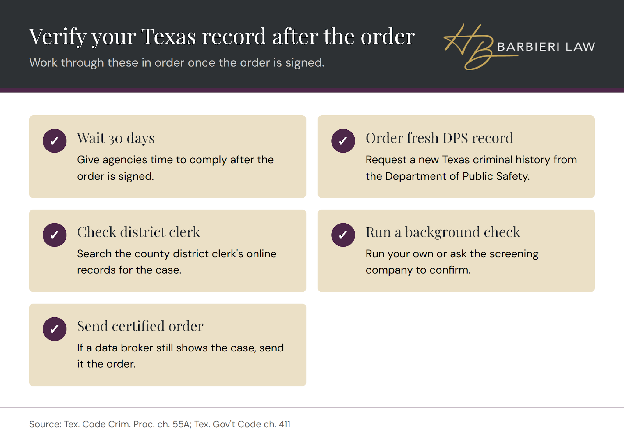
Figure 2: Check public and private sources, because a private screening company is the likeliest place a record survives. Source: Tex. Code Crim. Proc. ch. 55A; Tex. Gov’t Code ch. 411.
Which Misdemeanor Convictions Qualify For Nondisclosure?
Some first-time misdemeanor convictions can be hidden under Subchapter E-2, which is separate from the deferred-adjudication rules in E-1. Felony convictions and §411.074 offenses cannot be hidden.
E-2 applies when you were convicted and completed probation or a jail or fine sentence. It requires no prior conviction or deferred adjudication other than a fine-only traffic offense. First-offense DWI is the most common E-2 case, and the two sections below split it by case outcome.
Can A First-Offense DWI Be Nondisclosed?
Yes. A first-offense DWI conviction can qualify for nondisclosure under Subchapter E-2, but no DWI conviction can be expunged.
A DWI charge under Penal Code §49.04 is a Class B misdemeanor carrying 72 hours to 180 days in jail and up to a $2,000 fine. A BAC of 0.15 or higher makes it a Class A misdemeanor and removes nondisclosure.
The offense must not have involved an accident with another person, including a passenger. You must have no disqualifying prior offense, and you must have used ignition interlock where it was required.
The wait runs from completing the sentence. It is about two years with interlock and five years without, and a jail sentence instead of probation lengthens the shorter period to three years. Confirm the BAC finding and the judgment in the actual record before assuming you are eligible.
A Dismissed DWI Qualifies For Expunction
Yes. A DWI that was dismissed or no-billed can be expunged once it meets the Chapter 55A conditions, because no conviction exists.
A dismissal opens expunction, while a conviction opens only E-2 nondisclosure. The arrest-based rule still applies, so a separate charge from the same stop that ended in conviction can block the petition.
Frequently Asked Questions
Where Is The Petition Filed?
The petition goes to a district court in the county of arrest. That matters in Frisco, where the city spans Collin and Denton counties.
The district clerk in that county receives the filing and sets the hearing, and the petition must name every agency holding the records. The same rule applies in Dallas County.
Can Juvenile Records Be Sealed?
Juvenile records fall under Family Code Chapter 58, not Chapter 55A or Government Code Chapter 411. Sealing and restricted access work differently from adult nondisclosure. The rules depend on the adjudication outcome and the person’s age.
What We Review Before Recommending A Route
We start with the exact case outcome, the offense grade and the county, because those three facts fix the route. Our trial team reads the full arrest and court record, including every agency holding it, before anything is filed. We cannot predict a result, but the route we recommend rests on the actual record.
Our criminal defense team reviews the disposition paperwork and the arrest details. In-house reputation management works alongside the lawyers on what employers, schools and licensing boards may still see. Every conversation is private.