
Yes. For conduct on or after the 17th birthday, Texas treats a 17-year-old as an adult in criminal court, because Family Code §51.02 defines a juvenile “child” as a person 10 to under 17. At that birthday, juvenile court defense gives way to adult prosecution, and a charge can put a school place, a scholarship, a job and the family’s standing at risk.
Each answer below turns on how juvenile and adult charges are divided by date and grade. Our investigator works beside the lawyers from day one, so the defense starts on the facts at once.
Texas Family Code §51.02 Treats 17-Year-Olds As Adults
Texas Family Code §51.02 defines a “child” as a person 10 to under 17, so anyone who offends on or after the 17th birthday is prosecuted in adult criminal court.
Three ages follow different rules. Criminal responsibility begins at 17, civil adulthood at 18, and the age of consent under Penal Code §22.011 is 17.
At 17, arrest, bail, charging and trial follow the Code of Criminal Procedure exactly as for a 40-year-old. Juvenile court is the exception, tied to conduct before 17. Two paths cross that line: the offense-date rule and certification.
Does The Offense Date Or Arrest Date Control?
The offense date controls. Under Family Code §51.02(2), conduct before the 17th birthday stays in juvenile court even if the arrest comes later, and conduct on or after it goes to adult criminal court. Four date patterns come up most often:
- Offense at 16, arrest six months after the 17th birthday: juvenile court, because the conduct came before 17.
- Offense three days after the 17th birthday: adult criminal court from the start, with no juvenile route.
- Offense at 15, no filing until after the 18th birthday: transfer under §54.02(j) only for listed felonies, and only if the State shows it was not practicable to proceed earlier.
- Determinate-sentence case: juvenile supervision can run to age 19, with a hearing on release or transfer to the Texas Department of Criminal Justice (TDCJ).
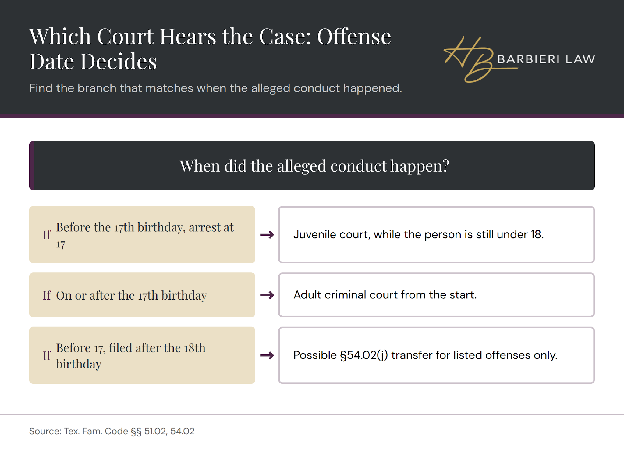
Figure 1: The date of the alleged conduct, not the date of arrest, decides juvenile or adult court. Source: Tex. Fam. Code §§ 51.02, 54.02.
We rebuild the timeline first from texts, location data, school records and witnesses. A proven offense date can move a case between courts.
What Happens When Police Arrest A 17-Year-Old?
Police process a 17-year-old as an adult. There is no parent-notice duty, and the teen sees a magistrate for warnings under Code of Criminal Procedure art. 15.17 and is held in county jail.
At 16, Family Code §52.02 requires prompt parent notice, §51.095 controls statements, and a §54.01 detention hearing decides release from a juvenile facility. At 17, art. 38.22 governs statements, and parents have no required role.
| Step | Age 16 (child) | Age 17 (adult) |
|---|---|---|
| Parent notice | Required, Family Code §52.02 | No parent-notice duty |
| Statements | Family Code §51.095 rules | Art. 38.22 rules |
| First appearance | Juvenile detention hearing | Magistrate warnings, art. 15.17 |
| Where held | Juvenile detention facility | County jail, separated from adults |
| Court | Juvenile court | Municipal, county or district court |
| Record | Adjudication, sealing possible | Adult record, expunction or nondisclosure |
Figure 2: At 17 the protections of juvenile procedure no longer apply at arrest, in court or on the record. Source: Tex. Fam. Code §§ 51.095, 52.02, 54.01; Tex. Code Crim. Proc. arts. 15.17, 38.22.
The county where the offense occurred prosecutes. Frisco sits in Collin and Denton counties, so the first question is which district attorney’s office has the case. An offense in Dallas goes to the Dallas County District Attorney.
Anyone under 18 held in county jail must be separated from adult inmates under Texas Commission on Jail Standards rules and the federal Prison Rape Elimination Act (PREA).
Adult Punishment Ranges For A 17-Year-Old In Texas
An adult 17-year-old faces Penal Code chapter 12 ranges, from a fine up to $500 for a Class C offense to 5 to 99 years or life for a first-degree felony. Class C cases go to justice or municipal court, Class A and B cases go to county court, and felonies go to a grand jury and then district court.
Most cases at 17 are ordinary: minor in possession, low-value theft, drug possession and assault. Violent felonies are the minority.
Misdemeanor Ranges Run To One Year
There are three misdemeanor classes: Class C (fine up to $500), Class B (up to 180 days and $2,000) and Class A (up to one year and $4,000). Typical charges by grade:
- Class C: minor in possession of alcohol, or theft under $100 under Penal Code §31.03.
- Class B: theft of $100 to under $750, or possession of up to two ounces of marijuana.
- Class A: theft of $750 to under $2,500, or assault causing bodily injury under §22.01.
A Class C citation still creates a criminal record. Misdemeanor defense can begin well before the court date on the citation.
Felony Ranges And Age-Based Limits
There are four felony ranges: state jail felony 180 days to 2 years, third degree 2 to 10, second degree 2 to 20, and first degree 5 to 99 years or life. Each allows a fine up to $10,000.
Possessing under one gram of cocaine is a state jail felony under Health and Safety Code §481.115. Firing at a home under the deadly conduct statute, §22.05(b), is third degree. Aggravated assault (§22.02) and robbery (§29.02) are second degree, and murder (§19.02) is first degree.
No one under 18 faces the death penalty, so capital murder (§19.03) at 17 means life with parole eligibility after 40 years. A juvenile determinate sentence under Family Code §53.045 tops out at 40 years.
Expunction And Nondisclosure For A 17-Year-Old’s Record
A case charged in adult criminal court at 17 loses automatic juvenile-record protection. It can be cleared only by expunction under Code of Criminal Procedure chapter 55A or nondisclosure under Government Code chapter 411.
A juvenile adjudication can be sealed under Family Code §58.003. Expunction destroys the records and applies mainly where there was no conviction. Nondisclosure hides records from the public, falls under subchapter E-1, and carries waiting periods and offense exclusions, such as family violence.
At 17 rather than 16, the arrest and any conviction stay public until a court order says otherwise. We map expunction and nondisclosure options at the outset, because the way a case resolves decides which remain available.
How Texas Certifies Teens Under 17 As Adults
Texas certifies a child under 17 as an adult only by a judge’s discretionary waiver under Family Code §54.02. There is no automatic transfer and no reverse certification.
Only felony allegations qualify, so misdemeanors cannot be certified, and the juvenile judge decides at a hearing. Descriptions of “mandatory adult jurisdiction” are wrong for Texas. The one mandatory step, §54.02(m), covers later felonies after a child has already been certified once.
Those juvenile and adult court differences carry into sentencing, records and parole.
Age And Offense Thresholds
Under §54.02(a), certification requires age 14 or older for the most serious felonies and 15 or older for the rest. There are two thresholds:
- Age 14 or older: capital, first-degree and aggravated controlled substance felonies.
- Age 15 or older: second-degree, third-degree and state jail felonies.
Age is measured on the offense date, the same rule that governs the line at 17.
Diagnostic Study And Certification Factors
Before a hearing, §54.02(d) requires a diagnostic study, a social evaluation and a full investigation of the child and the offense. Under §54.02(f), the judge weighs four factors:
- Whether the offense was against a person or property, with offenses against a person weighing toward transfer.
- The child’s sophistication and maturity.
- The child’s prior record and history.
- The prospects of public protection and the likelihood of rehabilitation.
We contest the study, the maturity evidence and the rehabilitation record before the hearing.
Determinate Sentencing Differs From Certification
Determinate sentencing keeps the case in juvenile court with a sentence of up to 40 years under §53.045, while certification moves it to adult criminal court. The sentence begins with the Texas Juvenile Justice Department (TJJD), and a hearing before age 19 decides release on parole or transfer to TDCJ.
Common Mistakes Made By 17-Year-Olds And Parents
Four mistakes come up repeatedly:
- Assuming a parent must be present for questioning: statements are usable if art. 38.22 is satisfied.
- Paying a Class C ticket: art. 27.14 treats payment as a no-contest plea and a conviction.
- Ignoring a summons or citation: this risks a failure-to-appear charge and a warrant.
- Misreading the age of consent: Penal Code §21.12, §22.011 and §33.021 can still apply.
Statements Without A Parent Are Usable
Yes, statements made without a parent are usable. A parent’s absence does not make a statement inadmissible, because art. 38.22 sets the warning and voluntariness rules for an adult 17-year-old.
Our review tests the warnings, the waiver, voluntariness and whether an oral custodial statement was recorded. Our investigator gathers the full interview file, including video and custody times.
Tickets And Summonses Carry Real Consequences
Paying a Class C ticket is treated as a no-contest plea and a conviction under art. 27.14. Ignoring a summons risks a separate failure-to-appear charge and a warrant.
A Class C ticket can be contested in municipal or justice court before any payment, through a not-guilty plea or a request for deferred disposition.
Age 17 Consent Still Carries Exposure
No, consent at 17 does not remove all exposure. Texas sets the age of consent at 17, but the authority-based provisions of §22.011, §21.12 (educator and student) and §33.021 (online solicitation) can still apply.
Section 33.021 defines a “minor” as under 17, so a 17-year-old messaging a 16-year-old is the adult under that statute. Educator and authority cases turn on the relationship, since §21.12 applies whatever the student’s age.
Allegations of sex crimes involving minors can carry sex offender registration. Close-in-age defenses tied to the age of consent depend on exact birthdates.
Next Steps For A 17-Year-Old’s Adult Charge
An adult charge at 17 puts a future and a name at risk, so the plan starts now. We confirm the offense date and forum, identify whether Collin, Denton or Dallas County prosecutes, and review statements and digital evidence. Our investigator starts on the facts from day one while the lawyers test the State’s case, prepare felony charge defense where the grade calls for it, and map record protection with school and employer in view.
Heather Barbieri has been Board Certified in Criminal Law by the Texas Board of Legal Specialization since 2005. Every conversation is private, and every case is handled with the discretion the stakes demand.