
The age of consent in Texas is 17, and sexual conduct with anyone younger can be charged as sexual assault of a child. What people call romeo and juliet laws are narrow close-in-age affirmative defenses that the accused must prove.
They do not make a teen relationship legal. An allegation like this puts a job, a license, a school place and a family’s standing at risk at once, and this post shows how the age math works.
These cases usually begin with a school report, an outcry to a parent, or messages found on a phone. A forensic interview of the young person follows, often at a child advocacy center. Below, we separate the trial defense from registry relief and flag related charges that use age 18.
The law stated here is current as of November 2026, and the 2027 question is answered at the end. This content is informational and not legal advice.
Texas Sets The Age Of Consent At 17
The age of consent in Texas is 17. Sexual conduct with a child younger than 17 is sexual assault of a child under Penal Code § 22.011(a)(2).
Texas has no charge called “statutory rape.” The State files it as sexual assault of a child under § 22.011(a)(2) or as indecency with a child under § 21.11. In both statutes, “child” means a person younger than 17.
The grades and ranges are set by statute:
- Sexual assault of a child: second-degree felony, 2 to 20 years in prison and a fine up to $10,000 (Penal Code § 12.33).
- Indecency with a child by contact: second-degree felony, same range.
- Indecency with a child by exposure: third-degree felony, 2 to 10 years and a fine up to $10,000 (§ 12.34).
A minor’s consent is no defense. If the child was younger than 14, the case moves to aggravated sexual assault under § 22.021, a first-degree felony carrying 5 to 99 years or life. Repeated acts over 30 days or more can be charged as continuous sexual abuse under § 21.02.
The collateral consequences outlast the sentence. Sex offender registration under Code of Criminal Procedure Chapter 62 can last for life for these offenses. Professional licenses and school enrollment are exposed, a felony conviction bars firearm possession under Penal Code § 46.04 and federal law, and the record appears on employer background checks.
What Is Texas’s Romeo And Juliet Law?
It is a popular label for the close-in-age affirmative defenses in Penal Code §§ 22.011(e) and 21.11(b). It is not one statute, and it does not make an act legal.
An affirmative defense is a fact the accused must prove to avoid a conviction. The State can still arrest, charge and indict. Under the “three-year rule,” the actor must be not more than three years older than the child, so a gap of exactly three years still qualifies.
Section 22.011(e) Defense Elements
The § 22.011(e) defense has four requirements:
- The actor is not more than three years older than the victim.
- The victim was 14 or older.
- The actor was not required to register for life under CCP Chapter 62 and had no prior reportable conviction or adjudication under § 22.011.
- The victim was not someone the actor was barred from marrying or living with as a spouse under Penal Code §§ 25.01 and 25.02, the bigamy and prohibited sexual conduct statutes that cover close relatives.
“Consensual” is not on the list. Consent is irrelevant to the offense, so the defense turns on ages, status and relationship.
Counting The Three-Year Gap
Compare exact birth dates, and use the ages on the offense date. A person who is 21 today but was 18 on the offense date is judged at 18.
Take an offense date of February 1, 2027, with a victim born August 15, 2011. On that date the victim is 15, so the 14-or-older element is met.
- Actor born August 10, 2008: three years and five days older, so the defense fails.
- Actor born August 20, 2008: five days short of three years older, so the age element holds.
- Actor born August 15, 2008: exactly three years older, so the defense still qualifies because the statute says “not more than.”
Five days separate the first and second actors. That is why we pull the birth certificates before anything else.
Indecency Defense Under Section 21.11(b)
The § 21.11(b) defense differs from § 22.011(e) in three ways. It requires an actor of the opposite sex, it requires that the actor used no duress, force or threat, and it sets no minimum victim age. The three-year limit and the registration bar still apply.
Same-sex couples cannot use § 21.11(b), but they may raise § 22.011(e) where its elements fit. The actor’s knowledge of the child’s age is irrelevant under § 21.11. The registry exemption under CCP Art. 62.301 uses different numbers again, and the sexting and online-solicitation statutes carry their own narrower rules.
| Rule | Age gap | Victim age | Other conditions |
|---|---|---|---|
| § 22.011(e) defense | Not more than 3 years older | 14 or older | No lifetime registration; not a prohibited relative |
| § 21.11(b) defense | Not more than 3 years older | No minimum | Opposite sex; no duress, force or threat |
| Art. 62.301 exemption | Not more than 4 years older | 15 or older | Petition after conviction or deferred adjudication |
Figure 1: The trial defenses and the registry exemption use different tests. Source: Tex. Penal Code §§ 22.011(e), 21.11(b); Tex. Code Crim. Proc. Art. 62.301.
Who Must Prove The Close-In-Age Defense?
The defendant must prove it. The defendant raises the defense and proves it by a preponderance of the evidence under Penal Code §§ 2.03 and 2.04.
Preponderance means more likely true than not. The evidence must be in the record before the jury is charged, or the judge will not instruct the jury on the defense.
Four records carry the age math: both birth certificates, school enrollment records, a first-contact timeline marked with both birthdays, and the actor’s registration status.
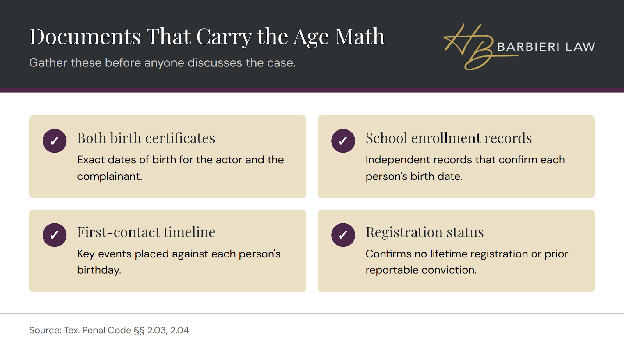
Figure 2: The defense is only as strong as the records that prove the dates. Source: Tex. Penal Code §§ 2.03, 2.04.
A fake ID or a dating-app profile listing an older age is no defense to the age element of § 22.011 or § 21.11. It can still matter to a prosecutor’s charging decision and to punishment. In online solicitation charges under § 33.021, the actor’s belief about age does count, because that statute defines a minor partly by what the actor believed.
How Do You Test A Texas Age-Gap Case?
Test it in six steps, in this order:
1. Age: Confirm whether the complainant was under 17 on the offense date.
2. Under 14: If so, § 22.021 exposure applies and there is no close-in-age defense.
3. Gap: Compute it from exact birth dates.
4. Status: Check lifetime registration, prior reportable convictions and the relative bar.
5. Statute: Confirm whether § 22.011 or § 21.11 is charged, since the defenses differ.
6. Registry: Test the Art. 62.301 petition separately.
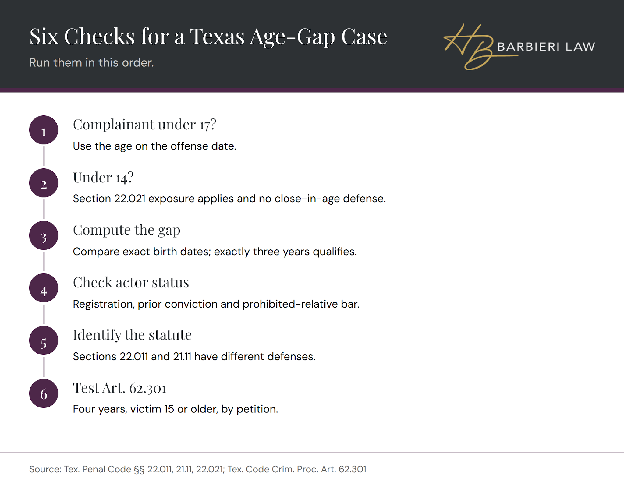
Figure 3: The trial defense and the registry petition are tested separately. Source: Tex. Penal Code §§ 22.011, 21.11, 22.021; Tex. Code Crim. Proc. Art. 62.301.
The registry exemption is a separate petition under CCP Arts. 62.301 and 42.017.
It applies when the actor was not more than four years older, the victim was 15 or older, and the case ended in conviction or deferred adjudication based on age alone. The trial defense uses three years and age 14, while the exemption uses four years and age 15.
An exemption lifts registration, but the conviction remains. The broader sex offender registration rules still shape the plan.
Is Texas’s Legal Age 17 Or 18?
Both, depending on the statute. Texas sets the age of consent at 17 for sexual assault and indecency, where a child is under 17, but uses 18 for several related laws.
Age 18 controls these:
- Sexual performance by a child, Penal Code § 43.25.
- Sale or distribution of harmful material to a minor, § 43.24.
- Electronic transmission of visual material depicting a minor, § 43.261, which has a narrow defense for dating partners not more than two years apart.
- Marriage, Family Code § 2.101, with narrow exceptions for emancipated minors.
Educator-student relationship charges under § 21.12 cover enrolled students regardless of the age of consent. That offense is a second-degree felony. The age of majority is a separate concept and does not set the age of consent.
Which Age Pairs Qualify For The Defense?
Each age pair is answered as “defense available,” “not available” or “different court,” never as legal or illegal.
- 17 and 21: not needed under § 22.011, because a 17-year-old is not a child under that statute. Check § 21.12 if the 17-year-old is a student, and check the 18-year statutes.
- 16 and 19, or 15 and 18: defense available if the birth-date math and the other elements fit. The State can still charge, and the defendant carries the burden.
- 17 and 14: defense available on age. The 17-year-old is an adult for criminal purposes in Texas.
- 15 and 12: not available, because the victim is under 14. That means aggravated sexual assault exposure, and the 15-year-old faces juvenile court charges.
When both people are minors, Family Code Title 3 governs delinquent conduct for ages 10 through 16. Rules on records, detention and transfer differ sharply between juvenile versus adult court.
Will Texas Change Consent Age In 2027?
No change to the age of consent in Texas exists as of November 2026. The 90th Legislature convenes in January 2027, and new laws normally take effect September 1.
The registry exemption shows that timing. The Art. 62.301 provision came from SB 198 and took effect September 1, 2011. Conduct before a law’s effective date is judged under the law then in force.
Two points cause confusion. A § 22.01 charge is assault, while § 22.011 is sexual assault. And under CCP Art. 12.01, there is no statute of limitations for sexual assault of a child or indecency with a child, so check the specific charge before assuming time has run.
How We Handle An Age-Gap Allegation
An age-gap case turns on birth dates, records and the exact statute charged. Sexual assault of a child is a second-degree felony carrying 2 to 20 years, with registration and license consequences that outlast the sentence. Frisco-area cases are prosecuted in the Collin County and Denton County district courts, and our trial team prepares each one as if it will be tried.
Head of Investigations Kim Voigt-Eanes, our in-house investigator, works the facts from day one. She works alongside a lead attorney, a second attorney and a paralegal case manager, with direct attorney access throughout. That is how Barbieri Law Firm, P.C. approaches the defense of sex crimes involving young people.
Every conversation is private, and every case is handled with the discretion the stakes demand. To schedule a confidential consultation, call or chat 24/7 at 972-646-8843. This content is informational and not legal advice.