A Texas state criminal case is charged under the Texas Penal Code by a county or district attorney in a state court. A federal criminal case is charged under the United States Code by a U.S. Attorney’s Office in a U.S. District Court, and federal charges follow different rules at nearly every stage. If you or someone in your family is under investigation, the fear reaches your job, license, school, family and the press as much as the courtroom.
Frisco sits in Collin and Denton Counties, so the first question is which prosecutor has the case: a county criminal district attorney or the U.S. Attorney’s Office for the Eastern District of Texas. Below, we compare the two systems on sentencing ranges, time actually served, record relief that exists only in Texas, and what happens when both governments act. Every conversation with our trial team is confidential.
Key Takeaways
- The prosecutor decides the forum: a county criminal district attorney files under the Texas Penal Code, while the U.S. Attorney’s Office for the Eastern District of Texas files under federal statutes.
- Federal sentences are not always longer on paper, but with no federal parole, a federal inmate serves about 85 percent of the sentence.
- Texas offers deferred adjudication, nondisclosure and expunction with no federal equivalent, and both governments can prosecute the same act.
What Makes A Criminal Case Federal?
A criminal case is federal when the United States, not the State of Texas, brings the charge. The U.S. Attorney’s Office files it under a federal statute, usually because the conduct touches a federal interest, and you cannot choose the forum.
A Texas case names a Penal Code offense with a Chapter 12 grade, such as a third-degree felony, and a county or district attorney prosecutes it. A federal case names an offense in Title 18 or Title 21 of the U.S. Code, and an Assistant U.S. Attorney prosecutes it.
One act can break both laws, so the same facts can fit either court. The prosecutors decide, and the investigating agency is the first clue.
Local police and sheriff’s offices build state cases. The FBI, Homeland Security Investigations, the DEA, the ATF, IRS Criminal Investigation and Postal Inspectors build federal ones.
Federal Jurisdiction Triggers
Five common triggers make a case federal: interstate commerce, internet use, a federal agency, federal property and a federal statute written for the conduct. Any one can be enough.
Interstate commerce reaches drug trafficking, where product, money or phones cross state lines. Interstate wires reach wire fraud, and a federally insured bank or federal program brings in a federal agency. Federal property covers a post office or a military base.
Internet use reaches online solicitation of a minor and child pornography. Courts treat the internet as a facility of interstate commerce, so a message between two people in the same county can be enough.
A federal statute written for the conduct covers felon in possession of a firearm under 18 U.S.C. §922(g). It requires only that the gun once moved across state lines, which nearly every firearm has.
Signs Of A Federal Investigation
Three formal signs point to a federal investigation: a target letter, a grand jury subpoena and a search warrant executed by federal agents. Each means the U.S. Attorney’s Office is already building a case.
A target letter is written notice from a federal prosecutor that you are a likely defendant. A grand jury subpoena orders a person or business to produce records or testify. Agents who appear at your home or office to ask a few questions are gathering evidence, and you may decline to answer until a lawyer is present.
Also watch for agents contacting your employer or bank.
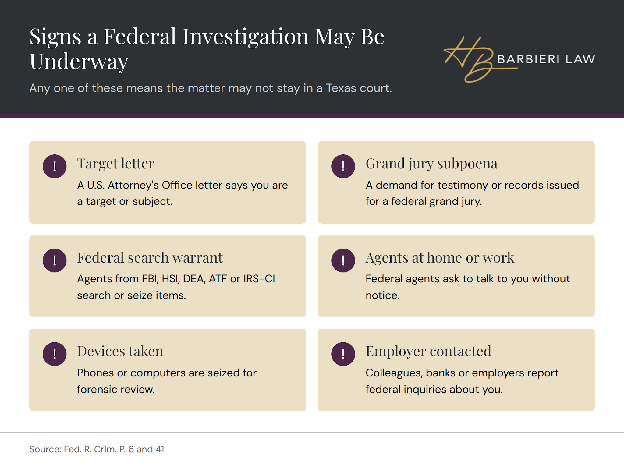
Figure 1: Federal involvement usually shows up in writing or in person before any charge is filed. Source: Fed. R. Crim. P. 6 and 41.
Defense work before an indictment can change how the case is charged. Counsel can speak with the prosecutor, supply records or context, and in some cases narrow the counts before a grand jury votes.
Which Courts Hear Frisco-Area Criminal Cases?
Collin and Denton County state cases go to county courts at law for misdemeanors and district courts for felonies, prosecuted by each county’s elected criminal district attorney. Federal cases from both counties go to the U.S. District Court for the Eastern District of Texas.
Collin and Denton Counties sit in the Eastern District’s Sherman Division, which holds court in Plano and Sherman. Dallas, Tarrant and Ellis Counties sit in the Northern District, with courthouses in Dallas and Fort Worth. Venue follows where the conduct occurred, so a Frisco resident can still be charged in Dallas.
A Collin County appeal goes to the Fifth Court of Appeals in Dallas. A Denton County appeal goes to the Second Court of Appeals in Fort Worth. The final Texas criminal court is the Texas Court of Criminal Appeals, not the Texas Supreme Court.
Federal appeals go to the U.S. Court of Appeals for the Fifth Circuit in New Orleans, then to the U.S. Supreme Court. The Fifth Court of Appeals is a Texas state court, while the Fifth Circuit is a federal court covering Texas, Louisiana and Mississippi. Our work on criminal appeals covers both ladders, and their deadlines differ.
How Texas And Federal Procedure Differ
Texas and federal procedure follow similar stages, but the rules inside them differ in ways that change strategy. The largest differences are grand jury size, speedy trial clocks, discovery, who sentences and appeal deadlines.
| Rule | Texas state case | Federal case |
|---|---|---|
| Grand jury | 12 members, 9 votes to indict | 16 to 23 members, 12 votes |
| Speedy trial | No statute; Barker v. Wingo test | 30 days to indict, 70 to trial |
| Discovery | Michael Morton Act, art. 39.14 | Rule 16 and Jencks Act |
| Who sentences | Defendant may elect jury | Judge always sentences |
| Notice of appeal | 30 days, TRAP 26.2 | 14 days, FRAP 4(b) |
Figure 2: Grand jury votes, trial clocks, discovery, sentencing and appeal deadlines all differ between the systems. Source: Tex. Code Crim. Proc. arts. 19.40, 37.07, 39.14; Tex. R. App. P. 26.2; 18 U.S.C. §3161; Fed. R. Crim. P. 6, 16;.
A Texas grand jury needs 9 of 12 votes to indict. A federal grand jury has 16 to 23 members and needs 12 votes under Federal Rule of Criminal Procedure 6.
The Speedy Trial Act, 18 U.S.C. §3161, sets federal clocks, but excludable delay for motions and continuances stretches them. Texas has no statutory clock. The Court of Criminal Appeals struck down the state act in Meshell v. State, so only the Barker v. Wingo balancing test remains.
Texas discovery runs through the Michael Morton Act, Code of Criminal Procedure art. 39.14, which requires the State to produce reports and witness statements on request. Federal discovery runs through Rule 16, and the Jencks Act lets the government hold witness statements until the witness testifies.
In Texas, the defendant may elect jury punishment under art. 37.07. In federal court, a judge always sentences. The notice of appeal is due in 30 days in Texas under TRAP 26.2 and in 14 days federally under FRAP 4(b).
Before trial, a Texas court sets bail. A federal case begins with a detention hearing under the Bail Reform Act, and certain drug and child-exploitation charges carry a presumption that the defendant stays in custody.
Is A Federal Sentence Always Harsher Than Texas?
No. Federal statutes can carry mandatory minimums and guideline pressure, but Texas ranges can be equal or higher for the same conduct.
Under Penal Code Chapter 12, a third-degree felony carries 2 to 10 years, a second-degree felony 2 to 20 years, and a first-degree felony 5 to 99 years or life. The real divide is mandatory minimums, guideline mechanics and where the case is filed.
Same Conduct, Different Ranges
For the same conduct, Texas and federal ranges cross in both directions. Texas is harsher on some drug weights, and federal law is harsher on online solicitation of a minor.
Federal possession with intent to distribute 500 grams or more of a cocaine mixture, 21 U.S.C. §841(b)(1)(B), carries 5 to 40 years. Texas possession of 400 grams or more of a Penalty Group 1 substance, Health and Safety Code §481.115(f), carries 10 to 99 years or life. The Texas floor is double, and it applies to possession alone, which matters to anyone facing drug trafficking charges who assumes the county is safer.
Online solicitation of a minor under Penal Code §33.021 is a second-degree felony, 2 to 20 years, or first-degree, 5 to 99 years or life, if the minor is younger than 14. Federal 18 U.S.C. §2422(b) carries 10 years to life.
Child pornography possession under Penal Code §43.26 is a third-degree felony, 2 to 10 years. Federal receipt or distribution under 18 U.S.C. §2252A(a)(2) carries a 5-year minimum and a 20-year maximum.
Unlawful possession of a firearm by a person with a prior felony conviction, Penal Code §46.04, is a third-degree felony, 2 to 10 years. The federal offense, 18 U.S.C. §922(g) with §924(a)(8), carries up to 15 years, and three qualifying priors trigger a 15-year federal minimum.
What Moves A Federal Sentence
A federal sentence moves on three things: relevant conduct, the advisory Sentencing Guidelines and government motions. Each shapes the decision to plead or go to trial.
The Guidelines have been advisory since United States v. Booker (2005), but judges must calculate the range first and rarely stray far from it. Offense level and criminal history drive the calculation.
Relevant conduct under USSG §1B1.3 counts uncharged conduct, such as drug quantity from other deals, proved only by a preponderance, meaning more likely than not. In Texas, extraneous offenses at punishment must be proved beyond a reasonable doubt under art. 37.07 §3(a)(1). A 2024 guideline amendment bars acquitted conduct from the guideline range.
A §5K1.1 substantial-assistance reduction requires a government motion, and Texas has no equivalent. A plea offer must be measured against the full relevant-conduct range, not only the charged count.
How Much Of A Sentence Is Actually Served?
On a 10-year sentence, a Texas inmate can reach parole eligibility after about 2.5 years of combined time, while a federal inmate serves about 85 percent, roughly 8.5 years, with no parole. The Texas figure applies only outside the 3g list.
Under Government Code §508.145, eligibility arrives when actual time plus good conduct time equals one-quarter of the sentence. Eligibility is not release, because the parole board decides, and our post on how parole works covers that hearing.
For 3g offenses, eligibility requires half the sentence in actual calendar time, with no good conduct credit: five years on a 10-year sentence. The 3g list includes aggravated sexual assault, sexual assault, indecency with a child by contact, continuous sexual abuse of a young child, aggravated robbery, and any felony with a deadly weapon finding, such as aggravated assault with a deadly weapon.
The Sentencing Reform Act of 1984 abolished parole for federal offenses. Good conduct credit under 18 U.S.C. §3624(b) is up to 54 days per year, about 85 percent served before First Step Act time credits, for which some offenses are ineligible. Release is followed by supervised release, and a violation can mean more prison time.
Which Texas Options Have No Federal Equivalent?
Four Texas options have no direct federal analogue: deferred adjudication, jury-recommended community supervision, orders of nondisclosure and expunction.
With deferred adjudication under art. 42A.101, the judge withholds a finding of guilt, and completion ends in dismissal. Under art. 42A.055, a jury may recommend community supervision for a defendant with no prior felony conviction.
An order of nondisclosure under Government Code chapter 411, subchapter E-1, seals a record from the public and most employers. Expunction under Code of Criminal Procedure chapter 55A destroys arrest records in qualifying cases, such as an acquittal. The plea chosen today decides which path to closing a record stays open later.
Federal probation is available only in limited cases, and deferred adjudication does not exist. A federal conviction cannot be expunged, and the only relief is a presidential pardon, which forgives but does not erase.
A federal guilty plea is permanent in a way a Texas deferred plea is not. That difference reaches background checks, licensing boards and universities, so it belongs in the reputation plan from the start.
Can Texas And The United States Both Prosecute?
Yes. Under the dual sovereignty doctrine, Texas and the United States are separate sovereigns, so a second case for the same act is not double jeopardy. When both can reach the conduct, the order and coordination of the two cases becomes the question.
Dual Sovereignty And The Petite Policy
Gamble v. United States (2019) confirmed dual sovereignty, and the Justice Department’s Petite policy, Justice Manual 9-2.031, limits but does not bar federal charges after a state case. The policy requires a substantial federal interest left unvindicated and senior Justice Department approval.
Under Setser v. United States (2012), a federal judge may run a sentence concurrent with or consecutive to a state sentence. A Texas judge holds stacking discretion under art. 42.08. Without coordination, one course of conduct can produce two sentences served back to back.
The sovereign that arrests first generally keeps primary custody until it finishes. A federal court borrows a state prisoner through a writ of habeas corpus ad prosequendum, an order to bring the person to federal court. That time can count toward the state sentence rather than the federal one.
Federal Enclaves And Federal Adoption
A DWI on a federal enclave is charged federally under the Assimilative Crimes Act, 18 U.S.C. §13, using Texas DWI penalties. A state arrest can also be dismissed and followed by a federal indictment, a practice called federal adoption.
On a military base, the case goes to the U.S. District Court, but the Texas range applies. A first DWI under Penal Code §49.04 is a Class B misdemeanor, 72 hours to 180 days in jail.
In an adoption, the county dismissal is not the end of the case. Expect agent contact or a grand jury subpoena, discuss the facts with no one, and hold any expunction filing. That window is when counsel can engage the U.S. Attorney’s Office.
Building The Defense Across Both Courts
Our trial team defends Texas state criminal cases in Collin and Denton Counties and federal criminal cases in the Eastern and Northern Districts, including Fifth Circuit appeals. We answer the forum question first, because it sets the range, the clock and the record relief available later. Our in-house investigators work the facts from day one, while reputation staff plan for the employer, school, licensing board and press, with nondisclosure or expunction in view where Texas law allows.
Work before an indictment is where options are widest. Barbieri Law Firm, P.C. handles every case with the discretion the stakes demand, and you can review our approach to federal criminal defense as a next step.