

Very few, if any, Texas criminal laws taking effect in 2027 have been enacted. The Legislature held no regular session in 2026, so the changes that govern charges today were passed in 2025, and bills filed for 2027 are not law. A charge filed near a new statute can threaten your job, your license and your name at once.
Our analysis reflects how these statutes are charged, bailed and defended in Collin, Denton and Dallas County courts, where our trial team handles felony charges defense from the first contact with police.
Facing a charge tied to a new or changing Texas statute? Talk with the defense team at Barbieri Law Firm before you speak with investigators or accept a plea offer.
Key Takeaways
- No new Texas criminal law is confirmed for 2027. The 90th Legislature convenes January 12, 2027, and most bills it passes will take effect September 1, 2027.
- The offense date, not the arrest, indictment or plea date, decides which version of a statute applies, and the ex post facto clauses bar raising punishment after the fact.
- The 2025 changes already govern current charges, including SB 9’s stricter bail rules and new or upgraded offenses under SB 20, SB 1621, HB 2695, HB 1778 and SB 1300.
Which Criminal Laws Take Effect In 2027?
No brand-new criminal law is confirmed among Texas criminal laws taking effect in 2027. The Legislature meets in odd-numbered years, and the 89th session ended in 2025. The laws now phasing in were enacted then.
According to The Texas Tribune, Gov. Greg Abbott signed 1,155 bills from the regular legislative session, including over 200 laws that went into effect immediately. Most criminal changes from that session already govern current charges.
Any section claimed for 2027 must be confirmed in the bill’s own effective-date clause. Until then, no row in a ledger should carry that year. A 2027 arrest for 2026 conduct is charged under the 2025 statutes, not under bills filed for 2027.
When Do 90th Legislature Laws Take Effect?
Laws from the 90th Legislature will mostly take effect September 1, 2027. The exceptions are bills that set another date and bills passed by a two-thirds vote of each house for immediate effect under Tex. Const. art. III, §39.
The constitutional default is the 90th day after adjournment, but most bills state September 1 instead. The Texas Tribune calls Sept. 1 the traditional date for laws passed during the regular session.
Only signed bills, or bills that become law without a signature, count. Nothing filed or pending in 2027 binds a court.
What Is The 2027 Session Timeline?
The 2027 session began with prefiling in November 2026. The 90th Legislature convenes January 12, 2027, and runs 140 days to May 31, 2027, followed by the governor’s veto window. Bill text and status come from Texas Legislature Online.
Six dates to track:
- June 2, 2025: the 89th Legislature adjourned. Its signed bills are law today.
- November 2026: prefiling for the 90th opened. Filed bills only, with no legal effect.
- January 12, 2027: the 90th convenes. Filed bills only.
- May 31, 2027: sine die, meaning final adjournment. Passed bills await the governor.
- 20 days after adjournment, excluding Sundays: the veto window closes under Tex. Const. art. IV, §14. Signed and unsigned bills become law, vetoed bills do not.
- September 1, 2027: the default start date. Most signed bills become enforceable.
Filed Bill Versus Law
A filed bill is a proposal, while an enrolled and signed bill is law. Enrolled means the final version passed by both houses. Even a signed bill is not enforceable until its effective date arrives.
Texas Legislature Online shows three statuses that matter for a charge:
- Filed bill: introduced or referred to committee. It changes no charge.
- Passed but not yet effective: enrolled and signed, or law without signature, with a future start date. It changes no charge until that date.
- Enrolled and signed law in effect: it governs conduct from its effective date forward.
The September 1, 2027 default applies only to bills that actually become law. Unsigned bills can still qualify.
The Texas Tribune reported that there were 140 bills the governor did not take action on, including 34 that took effect immediately. The same rule governs the gun bills filed for 2027, since each one changes no charge until it is signed.
Which 2025 Criminal Laws Are Still Phasing In?
The 2025 criminal laws still phasing in are SB 9’s bail sections, which started January 1 and April 1, 2026. Most other 2025 changes started September 1, 2025 and are already enforceable. The Texas Tribune noted that some 2025 laws were not set to activate until the following year, or until voters approve constitutional amendments in November, such as stricter bail policies.
The ledger has four start dates, and bill text for each is on Texas Legislature Online:
- September 1, 2025: SB 20, SB 1621, HB 2695, HB 1778 and SB 1300, all in force.
- January 1, 2026: SB 8’s provision on county sheriffs, and the first SB 9 bail sections.
- April 1, 2026: the remaining SB 9 sections.
- 2027: no 2025 criminal section verified.
One bill can carry several start dates. The section number matters more than the bill number.
SB 9 And SJR 5 On Bail
SB 9 changed bail by narrowing personal-bond eligibility and adding a Public Safety Report System. SJR 5 allows bail to be denied for certain violent felonies on a clear-and-convincing standard. A personal bond is release on a promise to appear, without cash or a surety.
SB 9 adds terroristic threat and unlawful carrying of a weapon to the personal-bond exclusions. SJR 5 amends the Texas Constitution, so it depends on the November 2025 vote. Confirm its status against the Secretary of State’s canvass before arguing it is in force.
At a first bail hearing in Collin, Denton or Dallas County, more defendants now face cash or surety bonds and stricter conditions. Each day in custody raises the chance that an employer or license board learns of the charge before the defense can respond.
What New Offenses Are Enforceable Now?
Four 2025 changes are enforceable now: AI-generated child-appearing material under SB 20 and SB 1621, HB 2695 on social-media drug delivery, HB 1778 on continuous promotion of prostitution, and SB 1300 on organized retail theft.
SB 20 and SB 1621 make covered AI-generated material a state jail felony, subject to enhancement. Charging turns on whether the material appears to depict a child.
That question now sits at the center of many internet crimes against children cases. Our review of the AI-generated image laws explains the wording in detail.
HB 2695 raises a controlled-substance delivery one category when social media is used. The State’s plea offer then starts from a higher range.
HB 1778 creates a first-degree felony and amends Code of Criminal Procedure articles 38.072 and 38.37, the outcry and other-acts evidence rules. SB 1300 lets prosecutors aggregate stolen-property value, so the total can reach first-degree.
Does A New Texas Penalty Reach Earlier Conduct?
No, a new Texas penalty does not reach earlier conduct. It applies only to an offense committed on or after its effective date. The ex post facto clauses of U.S. Const. art. I, §10 and Tex. Const. art. I, §16 bar raising punishment after the fact.
Bills write this into a savings clause. The usual wording says the act applies only to an offense committed on or after the effective date, and earlier offenses stay under prior law.
How The Date-Of-Offense Rule Works
The date-of-offense rule looks only at the date of the conduct. Arrest, indictment and plea dates do not change which statute version applies.
Take a bill raising an offense from a state jail felony to third-degree, effective September 1.
- Case A: offense August 31, arrest September 15, indictment November 3, plea February 10. Result: state jail felony.
- Case B: offense September 1, arrest September 1, indictment November 3, plea February 10. Result: third-degree felony.
Three of Case A’s four dates fall after September 1. Only the offense date controls.
Conduct Spanning The Start Date
When conduct spans the start date, the State may charge the post-effective conduct under the new law. The indictment’s date allegations then become decisive, and separate acts before and after the date may be charged under different versions.
Defense review focuses on what the State can prove occurred on which side of the line. Our investigator rebuilds the timeline from messages, records and digital evidence to test each alleged date.
How Much Does One Category Raise Punishment?
One category raises punishment at both ends of the range. A state jail felony (180 days to 2 years) becomes a third-degree felony (2 to 10 years). Penal Code sections 12.21 through 12.35 set each range and fine cap.
| Category | Confinement range | Maximum fine |
|---|---|---|
| Class B misdemeanor | Up to 180 days | $2,000 |
| Class A misdemeanor | Up to 1 year | $4,000 |
| State jail felony | 180 days to 2 years | $10,000 |
| Third-degree felony | 2 to 10 years | $10,000 |
| Second-degree felony | 2 to 20 years | $10,000 |
| First-degree felony | 5 to 99 years or life | $10,000 |
Figure 1: One category higher can multiply exposure, so the offense date and grade decide the real stakes. Source: Tex. Penal Code §§ 12.21–12.35.
Delivery of less than one gram of a Penalty Group 1 substance is a state jail felony under Health and Safety Code 481.112(b). Under HB 2695, social-media use moves that delivery to third-degree.
A first-degree offense cannot go higher. The minimum and fine rise instead, and the exact figures should be confirmed in the enrolled text.
What Are Texas DWI Classes And Felony Triggers?
Texas DWI classes start at Class B. A first DWI under Penal Code 49.04 is a Class B misdemeanor, not a felony. A felony requires a trigger such as a third DWI, a child passenger or serious injury.
Seven rungs on the ladder:
- First DWI: Class B misdemeanor, 49.04, with a 72-hour minimum jail term.
- Open container: still Class B, with a six-day minimum, 49.04(c).
- BAC of 0.15 or higher: Class A misdemeanor, 49.04(d).
- Child passenger under 15: state jail felony, 49.045.
- Third or later DWI: third-degree felony, 49.09.
- Intoxication assault: third-degree felony, 49.07.
- Intoxication manslaughter: second-degree felony, 49.08.
Some posts online claim a first DWI is now Class A, or that 0.15 BAC is a state jail felony. Neither matches the Penal Code, so check current statute text before relying on either.
DWI is the adult offense. DUI refers to a minor with any detectable alcohol. The grade on DWI charges also shapes license and employment consequences.
Which Steps Protect Cases Near Start Dates?
Six steps protect a case near a start date: fix the offense date, pull the statute version, compare grade and enhancement, test bail rules, audit any DWI blood warrant and test online-offense wording.
- Confirm the offense date from the complaint, indictment and evidence.
- Pull the statute version in force that day. The session law and its savings clause control.
- Compare grade and enhancement. Penal Code chapter 12 sets the range.
- Check bail rules. SB 9, SJR 5 and CCP art. 17 apply at the first hearing.
- Review DWI blood-warrant paperwork. Affidavit, issuing county and timing are tested against what probable cause requires, including cross-county warrants.
- Test online-offense wording. SB 20’s “appears to be a child” language must fit the material.
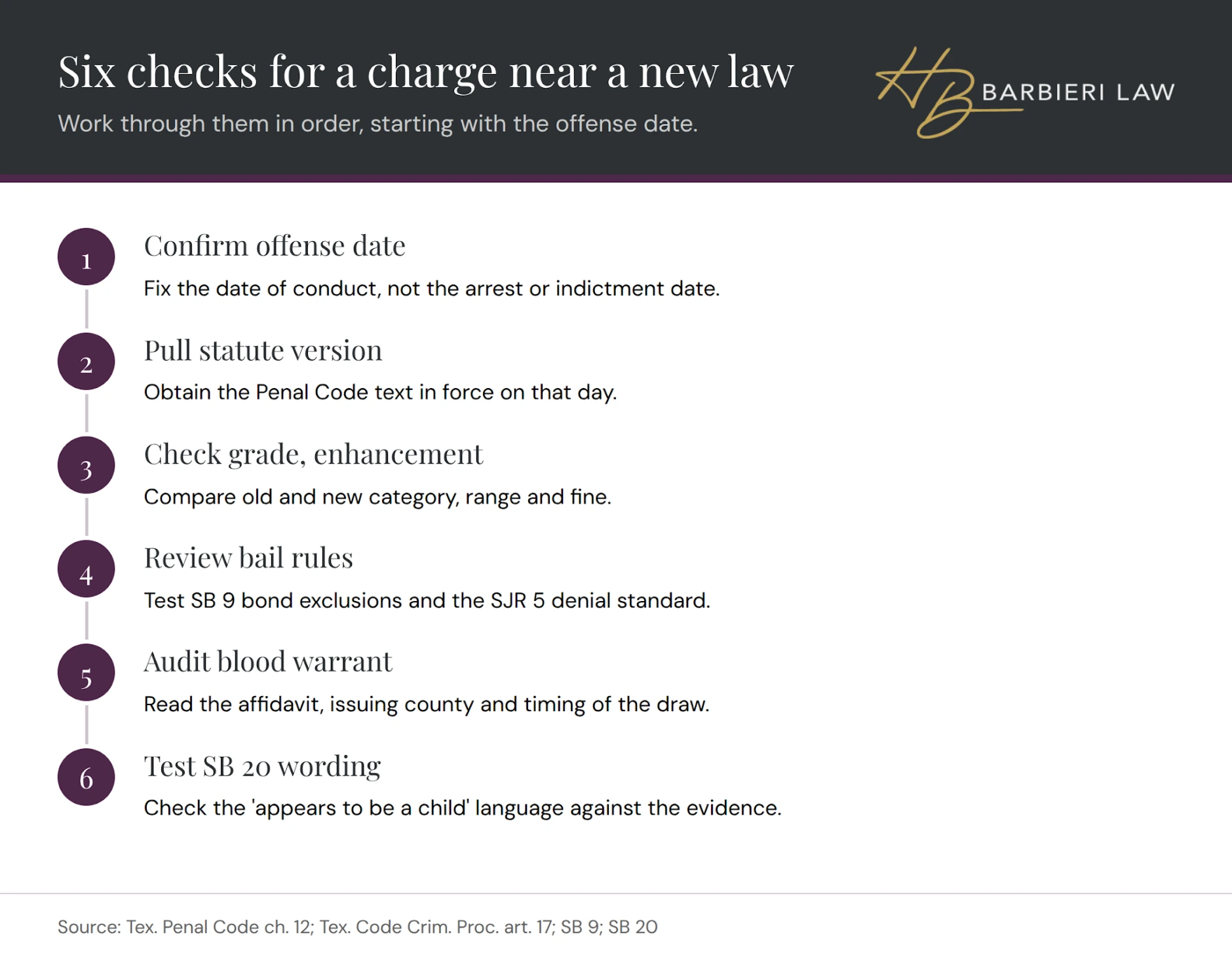
Figure 2: The offense date opens every other check on the statute, grade and bail. Source: Tex. Penal Code ch. 12; Tex. Code Crim. Proc. art. 17; SB 9; SB 20.
Each step has a reputation side. Bail conditions can restrict work and travel, and a charge can reach an employer, a license board or the press before trial.
Frequently Asked Questions
Can Felons Own Guns In Texas?
Generally no. Penal Code 46.04 bars a felon from possessing a firearm, except at the person’s residence after five years from release from confinement or supervision. Federal law, 18 U.S.C. §922(g), applies independently, and the Texas exception does not override it.
What Is Probable Cause In Texas?
Probable cause is a reasonable basis, from facts known to the officer or judge, to believe an offense occurred or evidence will be found. It governs arrests and search warrants, including DWI blood warrants.
Will A First DWI Be Dismissed?
Not automatically. Dismissal depends on the stop, the evidence, the testing and the facts, and prosecutors in each county evaluate cases individually. No outcome can be promised.
Common Law Crime Versus Statutory Crime
A common law crime comes from court tradition, while a statutory crime is defined by a legislature. Texas recognizes no common law crimes, because Penal Code 1.03 requires offenses to be defined by statute.
Our Team Reads The Statute Before The File
Our team reads the statute before the file because a charge near a new statute turns first on which version of the law governs. Head of Investigations Kim Voigt-Eanes starts the in-house investigation on day one. Former prosecutors on our trial team, including Managing Attorney Carrie Thomas, show how the State builds its case in Collin, Denton and Dallas County, from online allegations to the defense of drug delivery charges.
Reputation planning runs alongside the case, covering your employer, license board, school and the press. The goal is a closed record through expunction or nondisclosure where the law allows. No outcome is promised, but the information you give and the decisions you make stay in your control.